



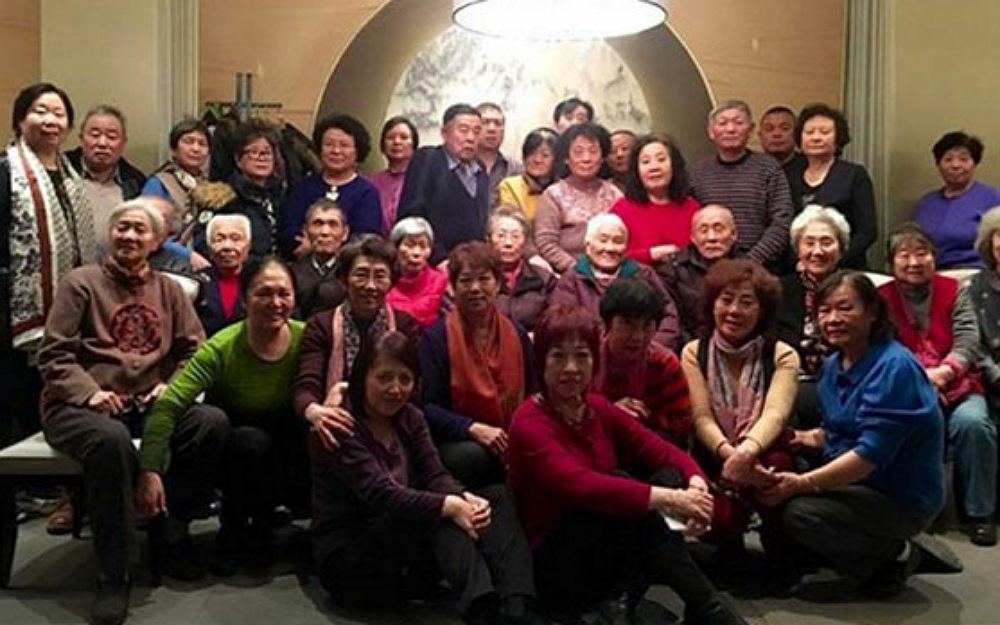
Family members of Tiananmen massacre victims and rights activists are being placed under surveillance on the 30th anniversary of the the declaration of martial law in Beijing during the 1989 democracy movement that took the country by storm.
Three decades after the student-led mass movement took hold of cities across China, prompting then supreme leader Deng Xiaoping to order the People’s Liberation Army (PLA) to clear Beijing through martial law, the loved ones of those who died in the ensuing massacre are under house arrest or on enforced “vacations” with the state security police.
Members of the victims’ group Tiananmen Mothers said the security measures had begun last week.
“I asked them what date they would be leaving on, and they said they didn’t know, but that it would probably be after June 4,” Tiananmen Mothers member Zhang Xianling told RFA on Monday. “They said they wouldn’t have to follow me everywhere if I would promise them not to talk to journalists.”
“I said that’s not likely, because I definitely want to give media interviews,” she said. “So now there’s someone sitting outside the lift, and another one sitting by the door to the stairs to make sure no journalists can come and visit me.”
“They also send someone to follow me if I go out, because they’re afraid I’ll meet with journalists somewhere else,” said Zhang, whose 19-year-old son died in the military assault on Beijing that began on the night of June 3, 1989.
“They follow me if I go to buy groceries, or go to the hospital,” she said. “They send a car, one of their cars, to take me, saying they’re afraid I’ll lose them if they let me take another car.”
Zhang said her cell phone is also being monitored.
“All of my communications devices are being monitored. They will hear everything we are saying,” she said.
Harassment takes a toll
The long years of official harassment appear to have taken their toll on Zhang.
“To start with when they would place me under surveillance, I could still get a bit angry about it,” Zhang told RFA. “Now it’s just boring; human rights violations are so common in China.”
Repeated calls to the cell phone of Tiananmen Mothers founder Ding Zilin were answered but immediately cut off on Monday.
Calls to the cell phone of group spokeswoman You Weijie rang unanswered.
Beijing-based rights activist Hu Jia said he is also under surveillance.
“The [state security police] follow us when we go to the hospital; they have even included my father’s home,” Hu said. “I went hiking on the outskirts of Beijing at the weekend, and they followed me all the way, and these were pretty remote mountains.”
Hu said he would be taken on an enforced “vacation” ahead of the sensitive 30th anniversary of the massacre.
“I will be forced to leave Beijing at some point between May 26 and May 28, the same as previous years,” he said. “I will be placed under surveillance somewhere else.”
Repeated calls to the Beijing municipal police department resulted in a busy signal during office hours on Monday.
Memorial in Taiwan
Meanwhile, former leaders of the 1989 protest movement gathered on the democratic island of Taiwan over the weekend to attend a symposium marking the 30th anniversary of the massacre.
Former Tiananmen student leader Wang Dan called for a re-linking of China’s human rights record to trade and economic relations.
“The only reason I got out of prison and was able to come to the United States was the link between trade and economic ties and human rights,” Wang said.
“Once trade became delinked from human rights, [China’s] Nobel peace laureate [Liu Xiaobo] didn’t get released. Instead he died in prison.”
“That’s the difference between linking trade and human rights, and delinking them,” he said.
Former student leader Zhou Fengsuo called on U.S. trade negotiators to target Chinese internet censorship, known colloquially as the Great Firewall, as part of ongoing trade talks.
He also drew parallels between the death of Liu Xiaobo in July 2017 and the death a century earlier of German pacifist Carl von Ossietzky, who died while serving a jail term for espionage after exposing the clandestine German rearmament in the 1930s.
“There was no vocal protest from the international community back then, which is pretty shameful,” Zhou said. “Now, Liu Xiaobo has basically already been forgotten.”
He cited the refusal by Columbia University’s C.V. Starr East Asian Library to host a donated bust of Liu Xiaobo earlier this year on the grounds that it represented a “political figure.”
This is the reality we are facing now,” Zhou said.
U.S.-based legal scholar Teng Biao agreed, warning that the mass, extrajudicial incarceration of Uyghurs and other ethnic minority Muslims in the northwestern region of Xinjiang could soon be exported elsewhere.
“Today’s Xinjiang is tomorrow’s China, and today’s China is tomorrow’s world,” Teng said.
Discussions banned
The 1989 protests, which took over Tiananmen Square for several weeks, were sparked by a spontaneous outpouring of public mourning following the funeral of ousted liberal premier Hu Yaobang on April 22 that year.
The government styled the 1989 student-led democracy protests a “counterrevolutionary rebellion,” and the families of victims and pro-democracy campaigners have since focused their efforts on a re-evaluation of that verdict, as well as demanding compensation and the apportioning of blame and responsibility for the massacre.
Public memorials and discussions of the events of June 1989 are banned in mainland China, with activists who seek to commemorate the bloodshed often detained, with veteran dissidents placed under police surveillance or detention during each anniversary.
The Tiananmen Mothers have been writing to China’s National People’s Congress (NPC) for more than 20 years, but say they have never had any kind of reply, only police restrictions.
The death toll from the night of June 3-4, 1989, when PLA tanks and troops entered Beijing, opening fire on unarmed civilians, remains unknown to this day.
While the Chinese government once put the death toll at “nearly 300,”it has never issued an official toll or list of names.
A 2009 map published by the Tiananmen Mothers listed more than 250 names garnered from confirmed eyewitness accounts and hospital records of those known to have died in the days after June 3, but it is unlikely to be an exhaustive account of casualties.
Reported by Wong Lok-to for RFA’s Cantonese Service, and by Hsia Hsiao-hwa for the Mandarin Service. Translated and edited by Luisetta Mudie.
Copyright © 1998-2016, RFA. Used with the permission of Radio Free Asia, 2025 M St. NW, Suite 300, Washington DC 20036