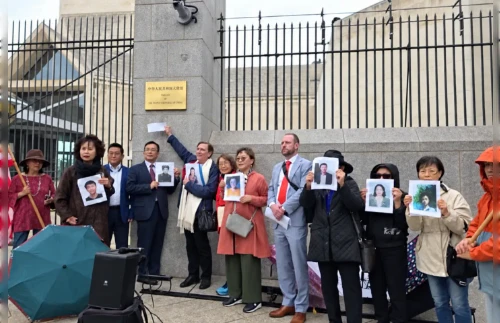




Declarations made at the Lhasa meeting affirm Beijing’s plan to fully absorb Tibet into China, experts say.

Chinese Communist Party officials in Tibet this month reaffirmed Beijing’s hardline policies pushing for Tibet’s complete assimilation into China’s dominant Han culture, calling for “political education” to further weaken Tibetans’ loyalty to exiled spiritual leader the Dalai Lama, according to state media reports.
Meeting in Tibet’s regional capital Lhasa on July 16, executive committee members of the Chinese Communist Party in the Tibet Autonomous Region reiterated declarations made by China’s president Xi Jinping in special high-level meetings on Tibet in August 2020.
Among these were that China had “liberated and reformed” Tibet and set the region on the path of economic progress during the last 70 years, and that Tibet’s traditional Buddhist religion should be made to adapt to socialist society and be “developed in a Chinese context.”
Also emphasized in the July 16 discussions were the “patriotic re-education” of the Tibetan people and the need to further undermine the influence in Tibet of the Dalai Lama, now living in India after fleeing Tibet into exile in 1959 following a failed national uprising against Chinese rule.
Speaking to RFA in interviews, Tibetan experts outside China said declarations made in the Lhasa meeting had reaffirmed China’s push to fully absorb Tibet into China by weakening and finally destroying Tibet’s unique culture, language, and national identity.
“The July 16 meeting was all about reiterating [Chinese President] Xi Jinping’s hardline policies set out during the Seventh Tibet Work Forum, and also his statements made during the 100th anniversary [in July] of the founding of the Chinese Communist Party,” said Bawa Kalsang Gyaltsen, the Dalai Lama’s representative in Taiwan.
“So this was a very significant meeting,” Gyaltsen said.
Safeguarding ‘national unity’
“The meeting also focused on safeguarding ‘national unity’ by labeling the Dalai Lama, the Central Tibetan Administration [Tibet’s India-based exile government], and Tibetans living in exile as separatists, and on bringing an end to the Dalai Lama’s influence on Tibet’s religious institutions,” he said.
“So these talks just confirm that China’s leadership is hell-bent on eradicating Tibetan identity, and that the Tibet issue continues to be among the Chinese leadership’s top priorities,” Gyaltsen said.
Jamphel Monlam, former assistant director of the Dharamsala, India-based Tibetan Centre for Human Rights and Democracy (TCHRD), noted that July, when the meeting “vilifying” the Dalai Lama was held, is also the birth month of the exiled spiritual leader.
“One could see that huge restrictions were put in place in Tibet during that month. But in spite of these restrictions and threats, the Tibetan people have still displayed their faith in the Dalai Lama, so the Chinese Communist Party identifies the influence of the Dalai Lama as the cause of instability [in Tibet],” Monlam said.
In February, TCHRD said that China’s development drives in Tibet have pulled the region closer to economic and cultural integration with Beijing but have failed Tibetans themselves, creating a “dual economy” that has seen rural Tibetans moved from traditional grazing lands and into urban areas where the best jobs are held by Han Chinese.
Formerly an independent nation, Tibet was invaded and incorporated into China by force 70 years ago. Chinese authorities maintain a tight grip on the region, restricting Tibetans’ political activities and peaceful expression of cultural and religious identity, and subjecting Tibetans to persecution, torture, imprisonment, and extrajudicial killings.
Reported by Yangdon Demo for RFA’s Tibetan Service. Translated by Tenzin Dickyi. Written in English by Richard Finney.
Copyright © 1998-2020, RFA. Used with the permission of Radio Free Asia, 2025 M St. NW, Suite 300, Washington DC 20036. https://www.rfa.org

Tibetan Mastiffs

LLM Phishing

UN Secretary-General Meets with Assistant Secretary-General for Africa in Departments of Political and Peacebuilding

North Carolina Police Encountered Two Men Travelling Down Couch Mounted on E-Scooter

Scottish Deerhound Dog Breed

AI-Powered Mortgage Fraud

Exclusive: North Korean Army Video Says K-Drama Watchers Deserve to be Executed