



The ruling Chinese Communist Party appears to be breaking with long-running culinary traditions, following a nationwide ban on the trade in wild animals, in the wake of the COVID-19 pandemic which had infected nearly 170,000 people globally by Monday.
A Feb. 24 decision by the National People’s Congress (NPC) standing committee banned trade in 1,591 protected species listed by the then State Forestry Administration in 2000, including civet cat, bamboo rat, and numerous species of snake.
“The hunting, trading and transportation of wild terrestrial animals for purposes of consumption are banned, according to the decision, which comes after the outbreak of novel coronavirus,” the official China Daily newspaper reported.
The Ministry of Civil Affairs in Beijing recently declared some of the actions of a wildlife industry that is worth an estimated U.S. $74 billion—breeding ostrich, snakes, crocodiles, frogs, and civet cats for consumption—illegal.
Much of the wild animal trade and China is devoted to fur and leather, but a significant proportion of turnover comes from selling animals for food.
The China Wildlife Conservation Association was forced to apologize earlier this month after a sub-committee of frog-breeders penned an article critical of the Feb. 24 ban.
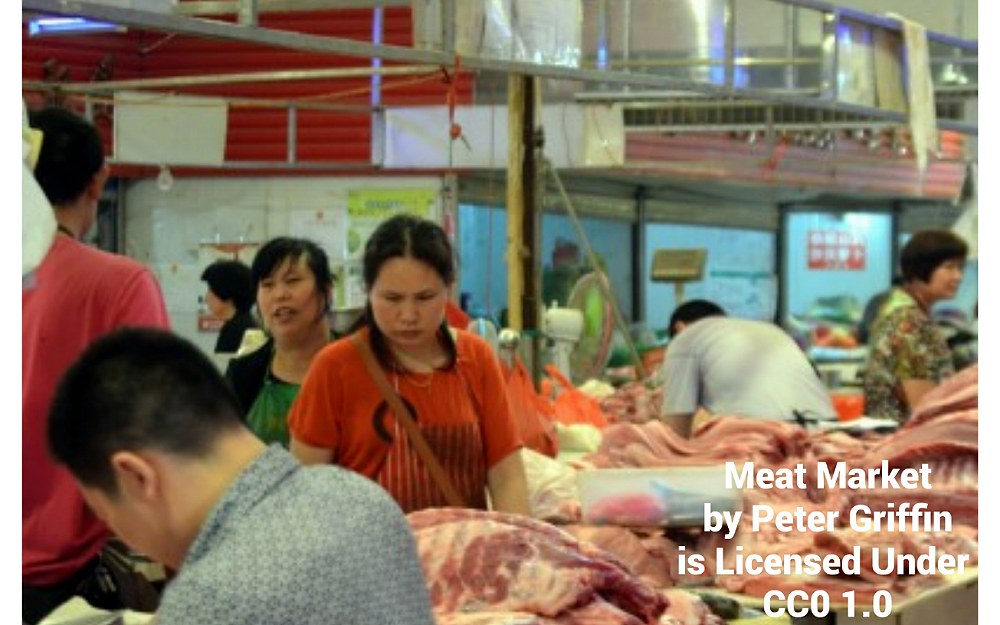
Unconfirmed reports indicate that the coronavirus outbreak centered around the Huanan Seafood Market in the central Chinese city of Wuhan, where wild animals were kept in close proximity ready for sale.
“Evidence says it’s [a] naturally occurring zoonotic disease that spilled over from wildlife,” the U.S.-based Wildlife Conservation Society (WCS) said via Twitter. “Likely from market in #Wuhan.”
“These markets can actually have 30, 40 wildlife species at the same time in the market,” the WCS’ Christian Walzer said in video statement. “The animals are alive in this market so they are actually shedding, they’re pooping, they’re sneezing, they’re coughing, so it’s very easy to exchange bodily fluids.”
“Then they’re being slaughtered on site as well, so then you’ll have the blood as well which is being mixed up,” he said. “It’s just an absolutely perfect cauldron of contagion and breeding ground for new viruses.”
‘Same operation’
Wildlife expert Wu Shibao of South China Normal University said part of the problem in China is that organizations that claim to protect certain wild species are also involved in trading them.
“The breeding and protection of wild animals is sometimes part of the same operation, when it shouldn’t necessarily be that way,” Wu told RFA. “So they have to be prudent at a time when a lot of things still aren’t clear.”
Gong Zengheng, founder of the U.S.-based Duoduo Project animal welfare group, said the authorities appear quite determined to stamp out the use of wild animals for food in the wake of the pandemic.
“They are trying to plug all of the loopholes they can think of,” Gong said. “Because there are huge loopholes in the law around the trade in any wild species.”
“There is no way of telling in a market whether the animals for sale were farmed or came from the wild.”
He said the government should have strengthened monitoring mechanisms in the wake of the 2002-2003 SARS epidemic, including spot checks on the provenance of animals for sale and health precautions around their slaughter with a direct appeal mechanism to the central government.
Government involvement
Conservationist Mang Ping said the move was a step in the right direction.
“This is a very important decision, and you could say it is unprecedented,” Mang told RFA. “It will protect wildlife, and the future of biodiversity, as well as changing people’s perception of wildlife and the need to respect nature.”
“This will have long-term significance, because it is legally binding.”
But Wu said the industry will need to be compensated and given an exit route.
“A lot of wild animal farming is actually legal and approved by the government,” he said. “It’s not just ordinary people doing it; the government is involved as well.”
The NPC Standing Committee also plans to amend the Wild Animal Protection Law, the China Daily said, while a draft revision to the Animal Epidemic Prevention Law is expected to be submitted to the committee for review in the near future.
The NPC is also fast-tracking news biosecurity laws, and is considering revising disease prevention laws to improve the public health emergency management system, it said.
Reported by Xue Xiaoshan for RFA’s Mandarin Service. Translated and edited by Luisetta Mudie
Copyright © 1998-2016, RFA. Used with the permission of Radio Free Asia, 2025 M St. NW, Suite 300, Washington DC 20036. https://www.rfa.org
Tibetan Mastiffs

LLM Phishing

UN Secretary-General Meets with Assistant Secretary-General for Africa in Departments of Political and Peacebuilding

North Carolina Police Encountered Two Men Travelling Down Couch Mounted on E-Scooter
Scottish Deerhound Dog Breed

AI-Powered Mortgage Fraud

Exclusive: North Korean Army Video Says K-Drama Watchers Deserve to be Executed

Press Briefing by Special Rapporteur on Sale and Sexual Exploitation of Children
Subscribe Our You Tube Channel

Fighting Fake News
Fighting Lies