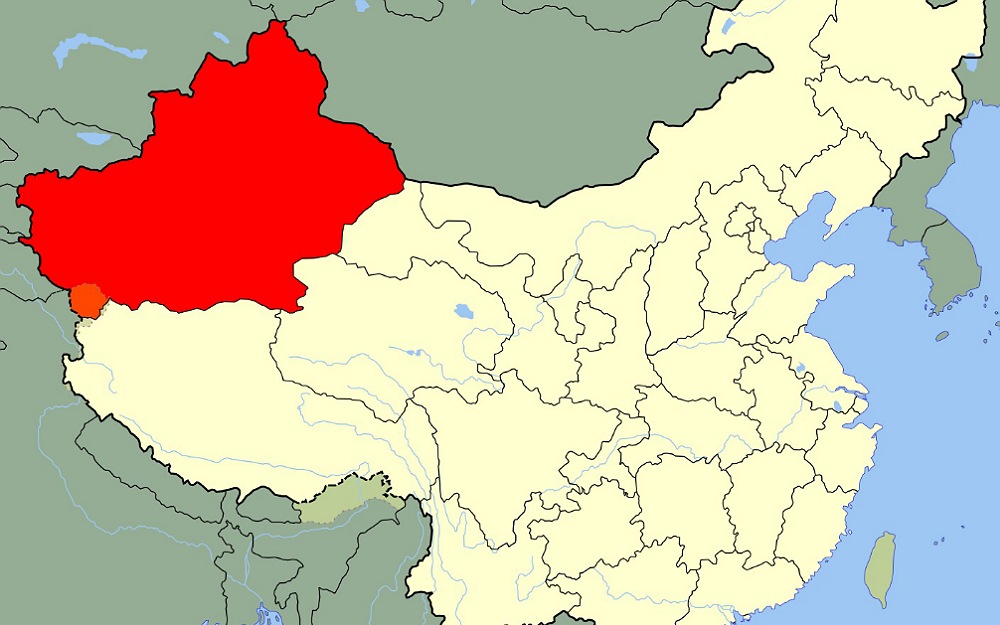
Residents of a county bordering the Xinjiang Uyghur Autonomous Region’s (XUAR) Kashgar (in Chinese, Kashi) city said Tuesday that they are under a strict lockdown as authorities struggle to control the spread of a new coronavirus outbreak.
The XUAR Health Commission announced 17 new cases of COVID-19, the disease caused by the coronavirus, in the XUAR on Monday, bringing the total number to at least 47 since infections were first reported in the region on July 15—months since the last positive test.
The new cases have sent regional capital Urumqi into a full shutdown, with authorities canceling nearly all flights in and out of the city of 3.5 million, shutting down public transportation, and ordering residents to remain in their homes.
The commission also confirmed the first patient in Kashgar, who it said was from Urumqi, according to the state media reports.
While there has been little information made public on the measures authorities have taken in Kashgar and the surrounding area to prevent additional cases, a resident of Kashgar prefecture’s Peyziwat (Jiashi) county, which abuts the city to the east, told RFA’s Uyghur Service on Tuesday that movement has become severely restricted.
“Barricades have been erected on every corner and they are saying that whoever leaps over them will be taken for ‘re-education,’ said the source, using a euphemism for the XUAR’s vast network of internment camps, where authorities are believed to have held up to 1.8 million people since April 2017.
“Of course, people are not only staying off of the streets, but they don’t dare to even go out to their own courtyards after hearing this warning.”
According to the source, who spoke on condition of anonymity for fear of reprisal, many county residents have prepared weeks’ worth of food supplies in anticipation of a prolonged shutdown and difficulties obtaining necessary supplies.
“Village officials are saying that we shouldn’t come out and whatever we need they will bring to us, but they also said the same thing last time,” the source said, referring to the original outbreak of the coronavirus, which spread to the region after it was first discovered in China’s Wuhan city late last year.
“However, they simply helped their relatives and left others to starve. We don’t know how it will play out this time.”
When contacted to confirm the situation in Kashgar prefecture and the wider region, an official from the XUAR Health Commission told RFA that he was restricted from discussing the outbreak with the media.
“If we have information to provide the media, it would only come after consulting with the relevant party organs,” he said.
Flag raising ceremony
Meanwhile, in neighboring Aksu (Akesu) prefecture, which has yet to officially report a new COVID-19, residents told RFA that while they continue to face restrictions on movement from the first coronavirus outbreak, other aspects of life have been less restrictive.
One source from Kuchar (Kuche) county said that it had been six to seven months since residents were permitted to visit other villages and more than three months since they were allowed to interact with their neighbors.
The woman, who also declined to be named, said that most of the men in the area “are in re-education” and that volunteers had been handling the farm work, “so even if we went out, there wouldn’t be much to do.”
“Since the [first] outbreak, the only changes we had in our lives was that we weren’t made to attend the [daily] flag raising ceremony,” she said, referring to an obligatory gathering at the village level where residents are required to sing the national anthem and listen to political lectures from party cadres.
“This made almost everyone happy … [although] for me, flag raising was not a burden, because using that pretext, I managed to see my neighbors and learn about what was happening around the world.”
An 80-year-old resident of Aksu’s Shayar (Shaya) county told RFA that it had been nearly seven months since she was made to go to a flag raising ceremony.
“I have a hearing issue, so even when I went, I couldn’t understand a thing, but the village officials made me go to fill up the ranks and ‘encourage’ others,” she said.
“We were told that flag raising would be restarted from next week, but it seems like we will be spared again. Other than that, there have not been any other changes.”
The woman said that her four adult children have all gone missing over the past four years and she has a 75-year-old brother who was recently released from an internment camp but is not allowed to see anyone.
“Even if I was given permission, I have nowhere to go, so I’m not afraid of the virus—I’m ready for what’s written in my fate,” she said.
Detainees at risk
Chinese authorities have instituted strict measures throughout the country as part of a bid to eradicate the virus after initially drawing criticism for a lack of transparency in handling the original outbreak in Wuhan. China has an official total of slightly more than 85,000 cases of COVID-19, but the coronavirus has gone on to infect nearly 14.8 million people worldwide.
Rights groups and experts have expressed particular concern about the potential impact of an outbreak in the XUAR, where they say limited access to health care and cramped conditions in the internment camps could allow the virus to spread virtually unchecked.
Beijing describes its three-year-old network of camps as voluntary “vocational centers,” but reporting by RFA’s Uyghur Service and other media outlets shows that detainees are mostly held against their will in poor conditions, where they are forced to endure inhumane treatment and political indoctrination.
As evidence of abuses in the XUAR continues to mount, Western governments have increasingly called out China for its policies in the region.
Earlier this month, U.S. President Donald Trump’s administration leveled sanctions against several top Chinese officials deemed responsible for rights violations in Xinjiang, including regional party secretary Chen Quanguo, under the Global Magnitsky Human Rights Accountability Act.
The move, which marked the first time Washington had sanctioned a member of China’s powerful Politburo, followed Trump’s enactment last month of the Uyghur Human Rights Policy Act of 2020 (UHRPA), which passed nearly unanimously through both houses of Congress at the end of May. The legislation highlights arbitrary incarceration, forced labor, and other abuses in the XUAR and provides for sanctions against the Chinese officials who enforce them.
Last week, China’s Foreign Ministry announced retaliatory sanctions targeting several republican lawmakers, Ambassador-at-Large for International Religious Freedom Sam Brownback, and the bipartisan Congressional-Executive Commission on China advisory panel.
Reported by Shohret Hoshur for RFA’s Uyghur Service. Translated by Mamatjan Juma. Written in English by Joshua Lipes.
Copyright © 1998-2020, RFA. Used with the permission of Radio Free Asia, 2025 M St. NW, Suite 300, Washington DC 20036. https://www.rfa.org

On Utah Highway, Semi-Truck Carrying French Fries Catches Fire
Tibetan Mastiffs

LLM Phishing

UN Secretary-General Meets with Assistant Secretary-General for Africa in Departments of Political and Peacebuilding

North Carolina Police Encountered Two Men Travelling Down Couch Mounted on E-Scooter

Scottish Deerhound Dog Breed

AI-Powered Mortgage Fraud

Exclusive: North Korean Army Video Says K-Drama Watchers Deserve to be Executed
Subscribe Our You Tube Channel

Fighting Fake News
Fighting Lies