



At Least 12 People Sentenced to Prison Since January 2018
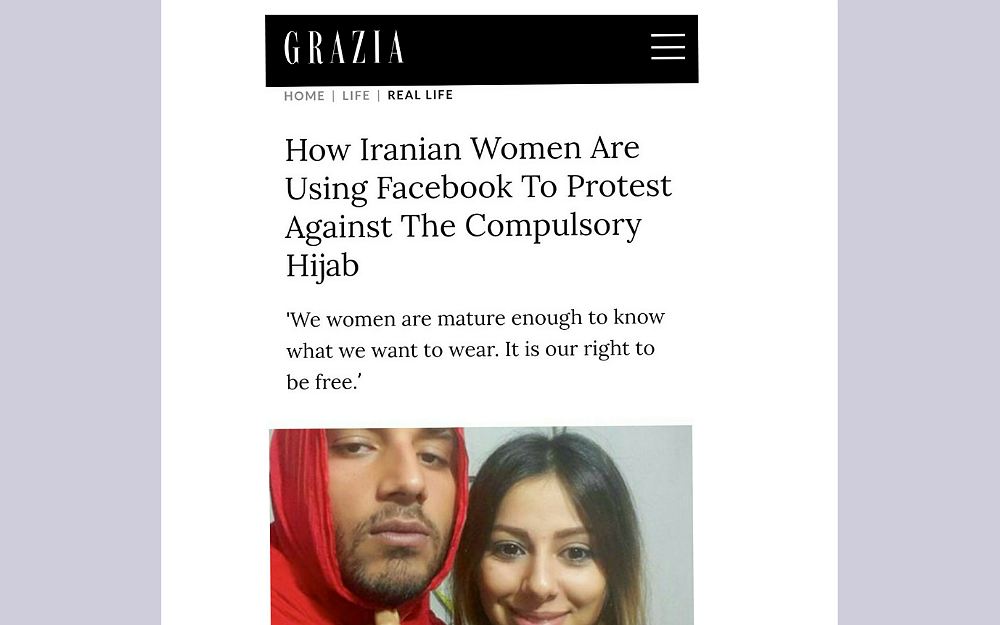
“Mounting arrests and prison sentences have not enabled Iran’s government to achieve broad public compliance with the country’s mandatory hijab law, or stem growing protests against it,” Center for Human Rights in Iran said in a press statement.
At least 12 people have been issued prison sentences ranging from six months to 33 years for publicly removing their headscarves and other public acts of civil disobedience against compulsory hijab since January 2018, and 32 have been arrested for such acts, according to research by the CHRI
“Wearing or not wearing a hijab is about freedom of expression, a fundamental and inalienable human right that should be defended,” said CHRI’s Executive Director Hadi Ghaemi.
“The Iranian authorities are employing the full machinery of the state to crush opposition to forced hijab, but with more than half the population against it, the tide is increasingly against them,” Ghaemi added.
A report on hijab that was based on surveys conducted by the Iranian Students Polling Association in 2006 and 2014 and released by the Rouhani administration in 2018 found that 49.2% of the Iranian population believed hijab is a personal matter and should not be made mandatory. The report acknowledged that “demanding” hijab in a society where so many see it as a personal and optional matter “is very difficult.”
A report by Iran’s Parliamentary Research Center released in March 2018 also found waning support for the hijab among Iranian society and proposed revising Iran’s mandatory hijab law as one possible approach, but nothing has been done legislatively since then.
CHRI calls on the authorities in Iran to immediately release the women and men who have been imprisoned for their peaceful acts of protest against mandatory hijab, and to cease criminalizing freedom of expression including the right to peaceful dissent.
CHRI further call on the relevant UN human rights bodies, including the special rapporteur on the situation of human rights in Iran and the special rapporteur on the promotion and protection of the right to freedom of opinion and expression, as well as governments worldwide, to urge the Iranian authorities to immediately release the individuals who have been imprisoned for their peaceful acts of protest against mandatory hijab.
CHRN alleges that for this basic act of civil disobedience against compulsory hijab, the authorities have charged these individuals with national security crimes.
According to Center for Human Rights in Iran, such charges reflect not only an attempt to vilify these women and men and discredit them in the public eye, they also serve to strip them of their due process rights, because national security-related charges in Iran allow the judiciary to deny access to counsel during the investigation stage.
The hijab protestors are also typically prosecuted under charges related to “morality,” such as “encouraging people to corruption and prostitution,” “insulting the sacred,” “removing the hijab in public,” “publishing indecent material on social media,” and “committing a forbidden act in a public space.” Such charges are blatant attempts by the authorities to smear and degrade the protestors in the eyes of the public.
Article 639 of Iran’s Islamic Penal Codestipulates one to 10 years of imprisonment for “anyone who establishes or directs a place of immorality or prostitution” or anyone who “facilitates or encourages people to immorality or prostitution.”
“The judicial authorities in Iran are equating the peaceful defense of freedom of expression with prostitution and immorality, reflecting the bankruptcy of judicial policy in Iran,” said Ghaemi.
At least 10 women and two men in Iran including Monireh Arabshahi and Yasaman Ariyani,Mojgan Keshavarz,Nasrin Sotoudeh, Azam Jangravi, Shima Babaei, Nasrin Sotoudeh are known to have been sentenced to prison under “morality” and “national security” charges for engaging in peaceful protest against forced hijab since January 2018.