



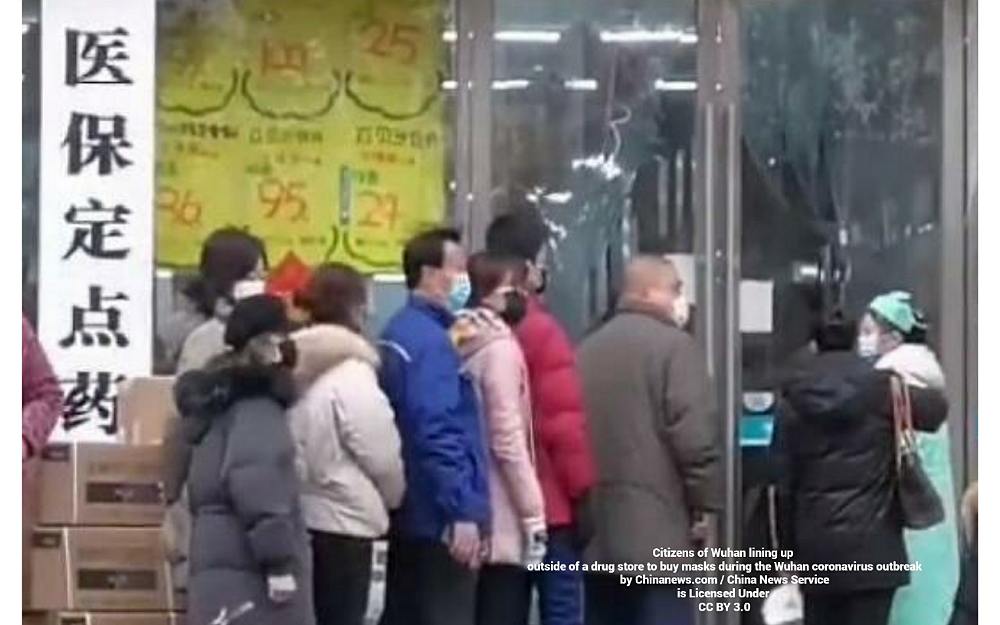
On Jan. 23, Chinese authorities locked down Wuhan, the Chinese city of 11 million at the center of the global coronavirus outbreak.
International health experts say the move has been critical to slowing the spread of the virus to the rest of the world by two or three weeks.
For many residents of Wuhan, the lockdown is a personal hell. VOA’s Mandarin Service spoke to several people about their experiences in a once-bustling city that has been reduced to an almost-deserted landscape because most people cannot leave their homes.
From strength to collapse
One month ago, Yang Jingjing posted the government-promoted slogan “Wuhan Jiayou!” (Wuhan Be Strong!) on her WeChat, showing solidarity with her fellow countryman. WeChat is a superapp online messaging platform that anchors China’s digital life.
One month later, the 28-year-old real-estate saleswoman said her world had collapsed.
On Feb. 21, Wuhan police notified her that her father’s body had been found on a roadside. He had been dead for several days.
Yang Yuanyun, 51, an employee of Wuhan Jiahua Automobile Plastic Parts Company, was the pillar of the Yang family.
On February 16, his wife discovered he hadn’t cooked for the day, as was the norm. Without his cellphone and wallet, he had left their home in Wuhan, leaving a last note to his wife on his cellphone:
People shrugged and went about their lives. Then on New Year’s Day, the government issued a special statement saying that news of the mystery illness was a rumor, and arrested eight people it accused of rumor spreading. Everyone applauded and believed the government was very efficient. People let their guard down and went about their business as usual
“I’m gone, won’t be able to accompany you for the rest of your life. There is no way out.”
Yang never pushed the “send” button. Today, the message remains in his draft box.
On the day he left, Yang also wrote some final words in a notebook:
“If this epidemic is playing a joke on me, I can make peace with that. If my sick body can be put in any use, I will dedicate it to medical research. May this disease not torture the world anymore!”
“He had been hiding it from me and my mom. He wouldn’t talk to us about his physical condition,” said his daughter Yang Jingjing, who had been quarantined in her apartment in Wuhan’s Wuchung district after returning from her parents’ home across town in the Hannan district. “I just want to find my dad.”
At the time, February 20, she had no idea that her father had died.
A few days after Yang Yuanyun’s disappearance, Yang Jingjing and her mother discovered he had been in touch with the family’s community social worker for several days via his WeChat. He told the social worker — repeatedly — that he had a fever and his chest was tightening. He begged them to put him in a hospital.
His community social worker responded that they could not find a hospital bed for him. Her words sounded indifferent.
“I don’t think you have any disease. You just think too much,” she replied in a WeChat text message.
Yang Yuanyun was last seen by a police surveillance camera on the southern bank of the Yangtze River, near Shamao Town in the Hannan district.
The Yangs’ neighborhood community center has not responded to inquiries from VOA.
“My mom never knew he asked for help from the community,” Yang Jingjing said, sobbing. “I called the community for accountability. They said I was harassing them. They said they have no liability at all. They asked me, ‘Why didn’t you, as the daughter, take more responsibility?’”
According to Chinese official statics, as of midnight Feb. 21, the day Yang Yuanyun’s body was discovered, there were 53,284 confirmed COVID-19 cases and 2,345 deaths nationwide.
Yang Yuanyun is not counted among these figures. The number of deaths like his — undiagnosed, unseen by medical practioners — remains a mystery.
A helpless firefighter
Xu Wu, 51, a former firefighter at Wuhan Iron and Steel Company, sobbed over the phone as he recounted his father’s ordeal.
On February 4, Wuhan doctors diagnosed his father with coronavirus. The community social workers said no hospital beds were available, and if there had been, there was no transportation available. Xu pushed his 80-year-old father in a wheelchair from one hospital to another. Yes, the old man’s condition was severe. No, he could not be admitted. No resources.
They visited another hospital Feb. 14. It rained heavily that day in Wuhan. On their way home, Xu accidentally dropped his father’s medical records, including lung X-rays representing weeks of effort to obtain a diagnosis. That evening, he watched his father eat a serving of Chinese red kale. Each mouthful was difficult. As for rice, he couldn’t even keep it down.
“I was so sad,” Xu said, his voice cracking. “I stayed up until 1 a.m. that day and contacted many people. I thought my father wouldn’t make it. I posted a message online for help.”
One day later, on February 16, a local hospital finally agreed to admit Xu’s father.
Xu was relieved, “It’s better to be treated in hospital than waiting to die at home.”
With his father in care, other worries dog Xu. The lockdown means Wuhan residents are banned from leaving their homes to shop for groceries. Instead of bumping into neighbors while selecting the makings for dinner, they rely on community social workers to deliver the basics such as vegetables and rice. The offerings they receive are largely on a take-what-you-get basis.
Xu is concerned that soon what feels like rations will run out and his family won’t have enough to eat. Addressing that fear, his mother planted some vegetables on the rooftop of their apartment building.
The family has already harvested a first crop of those with quick growing cycles. Xu said these homegrown vegetables are helping them survive the lockdown.
Witnessing tragedies
Lou Weichen is from Zhejiang province, about 660 kilometers southeast of Wuhan. The 25-year-old office worker made the eight-hour drive to Wuhan days after the lockdown because he wanted to volunteer.
Since then, every day has been the same. He drives from address to address to deliver necessities to those in need. Every day he witnesses unending tragedy.
“One family I helped out used to be a happy family of four,” Lou said. “The pneumonia took the father’s life. The mother went into the ICU because of the same disease. Then, the elder sister came down with a confirmed case and had to go to the hospital, too. The youngest son was put under quarantine at a local hotel.”
The sorrow has taken a psychological toll on Lou.
“I’ve been suffering from insomnia for a long time. Night after night, I couldn’t fall asleep,” he said.
Unrelenting pressure
One day shortly after the lockdown began, Chen Chen went to the hospital to deliver meals to her aunt, a doctor infected by the coronavirus in mid-January.
This 26-year-old office worker had never seen anything like this in her native Wuhan.
“It was around 5 or 6 p.m., nobody was on the street. It felt very much like being in a biochemical crisis type of movie,” said Chen Chen, who did not want VOA Mandarin to use her real name for fear of reprisal from local authorities.
“Many ambulances and police cars were parked in front of the hospital,” she said. “The atmosphere was very intense. The hospital was quiet, as if no one was there.”
A few days later, Chen Chen learned her uncle had COVID-19.
Then, after a few more days passed, doctors classified Chen Chen’s mother as a patient likely infected with the coronavirus.
The pressure felt unrelenting. Chen Chen wished she could sip milk tea at her favorite shop. Her mom longed for hot pot. But they were stuck inside and able to order only limited groceries for delivery.
“In early February, I felt really depressed. I even got a little skeptical of life,” Chen Chen said. “Every time you turn on the news, browse through Weibo, the death toll rises. I just stopped reading them.”
Weibo is China’s version of Twitter.
Chen Chen said she is angry, as are many other Wuhan residents she knows because news of a mysterious pneumonia began to circulate on WeChat in late December.
Chen Chen discussed the chain of events from then.
People shrugged and went about their lives. Then on New Year’s Day, the government issued a special statement saying that news of the mystery illness was a rumor, and arrested eight people it accused of rumor spreading. Everyone applauded and believed the government was very efficient. People let their guard down and went about their business as usual.
“Apparently it could have been controlled in the first place, but now we’re in this uncontrollable mess,” Chen Chen said.
Dubbed ‘Hubei F4’
She also told VOA that after the lockdown started on Jan. 23, she and other netizens would go on Weibo daily to vent their anger at local officials, calling them — the party chiefs of Hubei province as well as the governor and Wuhan’s mayor — “Hubei F4.”
The disparaging nickname originated with a Japanese manga series named Boys Over Flower. In it, four young men — F4 or Flower 4 — from Japan’s wealthiest families ruled an elite private high school.
Chen Chen and others wondered why the Hubei F4 hadn’t stepped down.
On February 13, the central government in Beijing removed the secretary of the Hubei Provincial Party Committee and the secretary of the Wuhan Municipal Party Committee. The news quickly spread on the internet. Many people said the government had done something great.
But Chen Chen thought things were not that simple and wonders why only two of the four local officials had been targeted.
“Who knows what exactly happened? Who gave the order to cover things up?” she said. “It can’t be just the four of them.”
Chen Chen then added that in China, for people like her, an ordinary citizen, there are some truths they may never know~VOA
VOA Mandarin Service reporter Ming Di contributed to this report

Tibetan Mastiffs

LLM Phishing

UN Secretary-General Meets with Assistant Secretary-General for Africa in Departments of Political and Peacebuilding

North Carolina Police Encountered Two Men Travelling Down Couch Mounted on E-Scooter

Scottish Deerhound Dog Breed

AI-Powered Mortgage Fraud

Exclusive: North Korean Army Video Says K-Drama Watchers Deserve to be Executed
Press Briefing by Special Rapporteur on Sale and Sexual Exploitation of Children
Subscribe Our You Tube Channel

Fighting Fake News
Fighting Lies