



Headlines
  • On Monday at 14:00 GMT, the US military says it would start blockading Iranian ports, preventing ships from entering or leaving Iran from passing through the Strait of Hormuz.
  • In the southern town of Biyyada, Hezbollah claims that its men have attacked Israeli soldiers with "a swarm of attack drones."
  • US President Donald Trump's threat to block the Strait of Hormuz was deemed "ridiculous" by Iran's navy chief, Shahram Irani.
  • Any military ships approaching the Strait of Hormuz "will be considered a violation of the ceasefire and will be met with severe force," according to a statement released on Sunday by Iran's Islamic Revolutionary Guard Corps (IRGC).
  • The speaker of Iran's parliament Mohammad Baqer Ghalibaf ​ is leading the delegation that has arrived to Pakistan for talks with the United States.
  • Nawaf Salam, the prime minister of Lebanon, stated that he was working to ensure the withdrawal of Israeli forces and to put an end to the Israel-Hezbollah conflict.
  • Viktor Orban, the longtime prime minister of Hungary, has conceded defeat to Peter Magyar in the country's legislative election.

More Details

United Nations Convention on Cybercrime

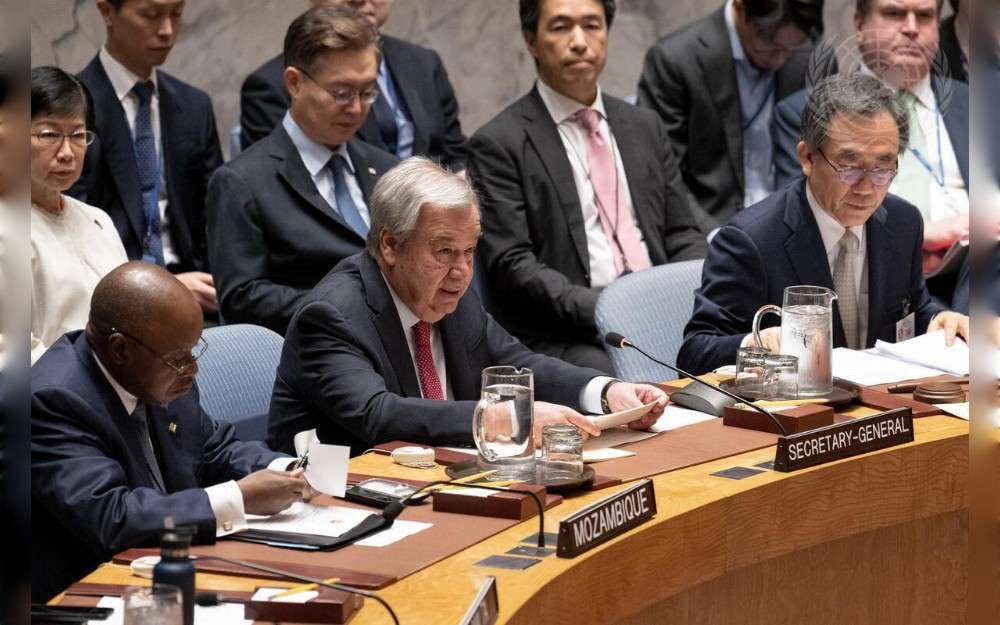
UN Secretary-General António Guterres (center) speaks at the Security Council meeting on addressing evolving threats in cyberspace on June 20,2024-UN Photo/Manual Elias

A growing threat for countries at all stages of development.At every stage of growth, nations are becoming increasingly concerned about cybercrime, which impacts both customers and According to the United Nations,although world over 156 nations have passed cybercrime laws, adoption rates differ by region, with Europe having the highest adoption rate (91%) and Africa having the lowest (72%).

The United Nations General Assembly adopted the United Nations Convention on Cybercrime on December 24, 2024, in New York, with resolution 79/243. As the first comprehensive international treaty on the topic, the Convention gives states a number of actions to adopt in order to prevent and combat cybercrime. In order to share electronic evidence for significant crimes, it also seeks to improve international cooperation.

More than 70% of hate crimes on social media target minorities, according to the UN Special Rapporteur on Minorities Issues, and this figure is still rising. Social media moderation systems are more likely to impose limitations or remove content from members of certain categories, according to the survey. Because they frequently lack strong cybersecurity infrastructure, developing countries continue to be especially vulnerable. The lack of resources and a lack of knowledge about cyber threats make people in these regions easy prey for crimes like identity theft, phishing, and disinformation.

However, new technologies like deepfakes and artificial intelligence present new challenges by enabling sophisticated disinformation campaigns and posing privacy concerns.The Convention also creates a worldwide framework to support judicial processes, investigations, and prosecutions, including asset recovery, extradition, and collaborative investigations.It makes cross-border access to electronic evidence simpler by implementing procedures including data interception, access, and preservation, backed by a round-the-clock contact point network for quick action.It describes the basic guidelines and protocols for mutual legal aid, saying that States Parties must support one another as much as feasible during investigations.

As a continuation of the global community’s joint efforts to fight cybercrime, the signing ceremony in Hanoi in July,2025 will be more than just a formal occasion. Expanding upon years of cooperation and advancement, the occasion will provide a forum to encourage communication, exchange best practices, and fortify alliances between important players, such as governments, international organizations, private businesses, and civil society.


Related Article

Computer Incident Handling

Businesses and organizations can create an effective strategy to guarantee cybersecurity by using in ...
April 13, 2026

Discretionary Access Control (DAC)

With discretionary access control (DAC), the owner of an object has the authority to decide who can ...
April 10, 2026

Malvertising

Malvertising, often known as malicious advertising, is a cyberattack technique that inserts maliciou ...
April 9, 2026

Spoofing and How to Prevent

Cybercriminals use a method called spoofing to pass off malicious communication or activity as from ...
April 8, 2026

Pharming

Pharming is a type of social engeneering cyber attack that uses malicious code to trick victims into ...
April 7, 2026

HoneyMonkey

HoneyMonkey is an automated system which scans various websites on the Internet using a network of c ...
April 6, 2026

Other Article

Prevent Cyber Crime

Computer Incident Handling

Businesses and organizations can create an effective strategy to guarantee cybersecurity by using in ...
April 13, 2026
News & Views

US to Set Up Philippines Fuel…

Washington is planning a fuel depot in the southern Philippines that could support humanitarian and ...
April 11, 2026
Pick of the Day

Press Briefing on Humanitarian Situation in…

Edem Wosornu, Director of the Crisis Response Division in the Office for the Coordination of Humanit ...
Bizzare News

Texas Woman Sentenced to Six Years…

After pleading a guilty plea to mailing synthetic cannabinoids and other drugs into facilities run b ...
April 10, 2026
Pet Corner

Coton de Tulear Dogs Breed

The Coton de Tulear is a small white dog breed that originated in Madagascar and is named after the ...
Prevent Cyber Crime

Discretionary Access Control (DAC)

With discretionary access control (DAC), the owner of an object has the authority to decide who can ...

Top