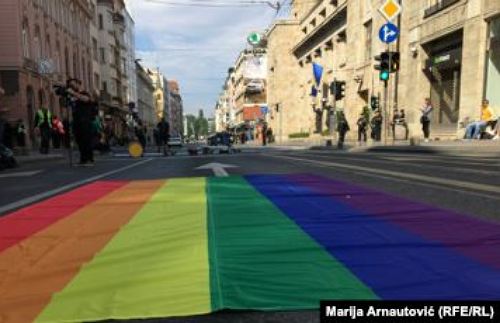




What many consider the first gay-pride march ever held in Central Asia has unleashed a storm of controversy in Kyrgyzstan, with threats of violence against participants, counterprotests, and fiery parliamentary debate over whether to rein in civil society.
The peaceful march by some 400 people in central Bishkek on Women’s Day on March 8 promoting women’s rights and “equality for all” was fiercely criticized by socially conservative lawmakers in the predominantly Muslim country.
“The men who do not want to have children and the girls who do not want to pour tea…must not only be cursed, they must be beaten,” Kyrgyz parliament deputy Jyldyz Musabekova wrote on Facebook of the lesbian, gay, bisexual, and transgender (LGBT) supporters who took part in the march in the Kyrgyz capital, with several of them carrying rainbow flags.
“We have to beat the craziness out of them,” she added. “Are there any decent guys out there [willing to do that]?”
She warned later during a March 13 debate in parliament that “if we sit silently…Kyrgyzstan will become a ‘Gayistan.'”
Musabekova’s comments were harshly criticized by some parliament members and on social media but echoed in gentler terms by other deputies.
Deputy Ziyadin Zhamaldinov said that in allowing the march to take place Kyrgyzstan had “disgraced” itself in front of neighboring countries. No women’s marches were held in any of the four other Central Asian states.
Zamaldinov’s colleague, Ainuru Altybaeva, said the march had “damaged” the concept of the traditional family.
Such comments are emblematic of a deep societal division within Kyrgyzstan, the region’s only democracy and arguably its most progressive country.
‘Very Proud’
Human rights activists were quick to defend the Women’s Day march and excoriate deputies for their remarks.
“We are not offended by this parliament — these deputies have in past years expressed even more absurd ideas,” rights activist Tolekan Ismailova said.
“I think it’s very cool that the LGBT community came on the march, because this is also related to the rights of women if we are talking about lesbians and transgender girls who face tremendous violence in Kyrgyzstan,” said Bektour Iskender, the founder of the popular Kloop.kg website and a participant in the march.
“This is part of the women’s rights movement — it’s impossible to separate them. And I’m very proud of Kyrgyzstan that this has become possible here.”
Iskender added that it wasn’t the only time that supporters of sexual minorities in Kyrgyzstan had been taking part in the women’s march — only that this was the first time opponents of the LGBT community had noticed.
“I urge people in Kyrgyzstan to stop being afraid of LGBT people — they’re also part of our society,” he said. “I think that parliament deputies would also do well to get some kind of education in the field of human rights, because they’re saying some very uneducated things.”
30 Or 40?
Bektour told RFE/RL that this year’s women’s march had more participants than in previous years because of actions by the nationalist 40 Warriors (Kyrk Choro) organization, which had made threats to marchers and city officials allowing the event to be held.
City officials initially tried to discourage organizers from the Bishkek Feminist Initiatives (BFD) from holding the march, saying that it could cause traffic jams and lead to confrontations.
But the BFD was undeterred.
“The city police told us that for ‘security reasons’ you should not go out because members of Kyrk Choro could ‘come and do something,'” BFD representative Gulaiym Aiylchy said. “We told them that despite your warnings we will still come out [and march].”
While there were 40 Warriors members present at the march, they didn’t directly interfere with the procession. However, they are accused of making threats to female activists and others who attended.
Rights activist Rita Karasartova, political analyst and former government deputy minister Edil Baisalov, and ex-lawmaker Ravshan Jeenbekov also said they had been intimidated or threatened for taking part in the march.
40 Warriors was also criticized for the behavior of its leader, Zamirbek Kochorbaev, who was accused of intimidating Mira Tokusheva, a march organizer, during a public TV program on March 11 in which he said he had the organizers’ “addresses.”
40 Warriors called on March 11 for Bishkek Mayor Aziz Surakmatov to resign for permitting the march, and two days later the nationalist group held a counterprotest in front of parliament, warning its members that it and its “thousands” of supporters would take action if lawmakers did not.
Only about 30 people attended the nationalist group’s rally. “We propose that 40 Warriors rename themselves,” Iskender said, “to 30 di**heads.”
Sociologist and anthropologist Altyn Kapalova said the statements by deputy Musabekova on social media and in the parliament may have violated the law.
“What Musabekova wrote can be regarded as a violation of the fundamental rights of every Kyrgyz citizen,” she said. “It is not just rudely expressed, but also calls on other people to commit violence. To this we must not just respond but bring to justice.”
Blaming NGOs
The debate in parliament on March 13 included the national security agency deputy chairman, Orozbek Opumbaev, who said he “shared” deputies’ concerns about the participation of LGBT members in the Women’s Day march.
He told the deputies it was “necessary” to pass a law similar “to what was adopted in Russia” that would monitor the finances of NGOs — a reference to the controversial “foreign agents” law passed in Russia in 2012.
“This is the main problem — that the financing [of NGOs] goes unchecked,” he said. “In particular, on LGBT [groups]. How much money comes in [from abroad]?” he asked. “If we pass this law we have control.”
For activist Ismailova, the idea is a nonstarter for Kyrgyzstan, where there are more than 14,000 registered NGOs.
To those who say that NGOs should be checked, I would say: Read the constitution! NGOs openly show where they get funding from, provide all reports, and pay taxes,” she said. “The companies of [some parliament] deputies do not pay as much taxes as we do.”
(Writtenby Pete Baumgartner based on reporting by RFE/RL Kyrgyz Service correspondents Ernist Nurmatov, Eleonora Beyshenbek Kyzy, and Kasym Rakhmankulov, and Current Time)
Copyright (c) 2019. RFE/RL, Inc. Reprinted with the permission of Radio Free Europe/Radio Liberty, 1201 Connecticut Ave NW, Ste 400, Washington DC 20036.