



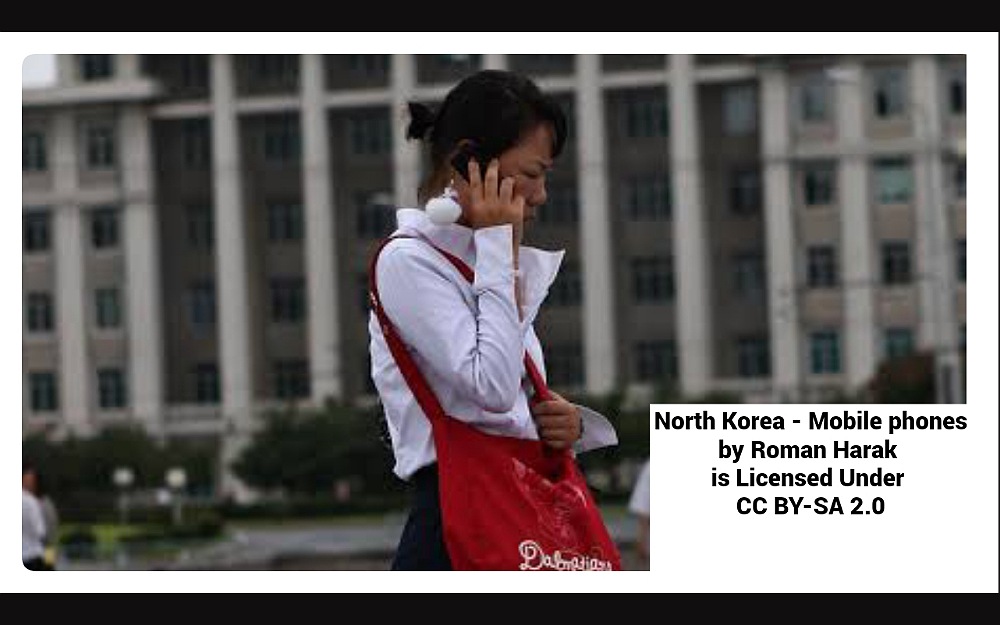
North Korea has arrested 20 “phone brokers” who arrange calls and money transfers from outside the country in a nationwide crackdown on illegal mobile phone users, sources familiar with the cases told RFA.
The accused — some of whom were moonlighting security officials — were arrested in the Ryangang provincial capital Hyesan, a northern city on the Chinese border, after they were caught arranging phone calls and remittances between North Koreans and their relatives in China and South Korea.
“They were arrested on charges of contacting the outside world and using Chinese mobile phones, which are prohibited,” a law enforcement official from Ryanggang province, who requested anonymity to speak freely, told RFA’s Korean Service Tuesday.
Phone brokers in parts of North Korea close enough to the border to access Chinese mobile networks earn money charging high fees to help North Koreans living abroad send remittances to their family members through China.
“I checked the list of people caught using Chinese mobile phones this month, as well as written documents on how they were arrested,” the official said, adding that that they were all caught while trying to contact North Korean exiles in China and South Korea.
The source said that after the arrests, “escapees in South Korea and China probably won’t find it as easy to contact their families or other residents in Hyesan.”
The arrests are part of a larger crackdown that began last month, following deployments of special forces to the border regions near China to stop travel in the name of coronavirus prevention and to crack down on smuggling.
“The provincial security agency launched an operation to find and exterminate all those who bring in outside information and leak internal information in the North Korea-China border area by the end of the year, in accordance with the Highest Dignity’s orders,” the source said, using an honorific term to refer to North Korean leader Kim Jong Un.
Corrupt watchmen
The source said that some of the arrested phone brokers are city or provincial secret intelligence agents, who were supposed to have been the “eyes and ears of the state,” but acted as phone brokers themselves for years.
“They made money by selling internal information to South Korea or by working as remittance brokers while on duty as secret intelligence agents,” the source said.
“Controlling and punishing users of Chinese cell phones in the border area has been a constant, but this is the first time they’ve arrested secret agents who help the security department. As the Highest Dignity has ordered [the crackdown], it will be difficult for those arrested to avoid strict punishment,” the source said.
Another source, a resident of Hyesan who requested anonymity for security reasons, told RFA that many of the arrests happened in public view in many different parts of the city.
“On the 8th, I saw a hand-cuffed resident being carried away in a car by provincial security agents in Yonpung-dong,” the second source said.
“On the 11th and 14th local residents witnessed the arrest of one resident in Hyegang-dong and another in Hyesin-dong. The provincial security department is conducting an intensive crackdown on people using Chinese cell phones,” said the second source.
“In the past they used to just scare illegal cell phone owners during questioning, and then have them spend some time in detention facilities or let them get away with just attending education classes, but this time it is unlikely to end like that—the arrested residents are probably going to be sent to a prison or disciplinary labor camp,” the second source said.
But the second source said the crackdown will add to the hardships of the many people in the province who rely on remittances for survival, especially since North Korea and China closed their 1,420-km (880-mile) border in January and suspended all trade in response to the coronavirus.
Coupled with UN sanctions aimed at halting resources and cash that could be channeled into Pyongyang’s nuclear and missile programs, the border closures all but killed local commerce. Remittances remained the only source of income, keeping the whole local economy afloat.
“The border has been sealed, but the market kept circulating only thanks to the people who bring in illegal remittances from China. Now that they are arrested, we may just have to sit around and wait to die,” the second source said.
Family ties
Refugees who have escaped the country told RFA they have felt the effects of the crackdown.
“I usually make phone calls with my family in North Korea every week, but this month I have not been able to call my family in Hyesan for the past 15 days,” a North Korean refugee who settled in South Korea in 2018 told RFA Tuesday.
“In North Korea, whatever you do, everything is controlled by the authorities… I’m worried that I haven’t been able to contact my family in my hometown lately, so I’m worried about their safety,” said the refugee, who declined to be named.
The refugee said the crackdown was especially worrisome because those found using Chinese cell phones could be harshly punished if authorities decided to arbitrarily accuse them of espionage.
RFA reported earlier this month on one such case, when a phone broker from North Hamgyong province in the country’s northeast was accused of espionage. Sources said they expected he would be shot by firing squad.
While the exact number of illegal phone users in North Korea is unknown, the Database Center for North Korean Human Rights, which interviewed 414 North Koreans in the South, reported that 47 percent of them were in constant contact with their families in the North in 2018. Of those, about 93 percent said they called their families on the phone.
In the same survey, 62 percent said they had sent money to North Korea. Based on their answers, the center estimated that refugees in the South who send money to North Korea do it about twice per year, sending around 2.7 million South Korean won (U.S. $2,260) each time.
Each time they had to pay an average broker fee of almost 30 percent.
According to South Korea’s Ministry of Unification, 32,000 North Koreans have settled in South Korea since 1998, including 1,047 last year.
Reported by Sewon Kim for RFA’s Korean Service. Translated by Leejin Jun. Written in English by Eugene Whong.
Copyright © 1998-2020, RFA. Used with the permission of Radio Free Asia, 2025 M St. NW, Suite 300, Washington DC 20036. https://www.rfa.org

Award-Winning Burmese Journalist Shin Daewe Released from Prison
UN Security Council Meets on Situation in Sudan and South Sudan
Mexican’s Zoo’s Star attraction Yuji, Abandoned Newborn Monkey
Sinhala Hound
UN Permanent Representative of Israel Briefs Press

Web Cache Poisoning
Michigan Delivery Driver Shot Missing Dog, Found Alive After Bullet Bounced Off Skull
Subscribe Our You Tube Channel

Fighting Fake News
Fighting Lies