



Officials say the system is the best way to educate a scattered population. Critics call it forced assimilation.
By Lobsang Gelek for RFA Investigative
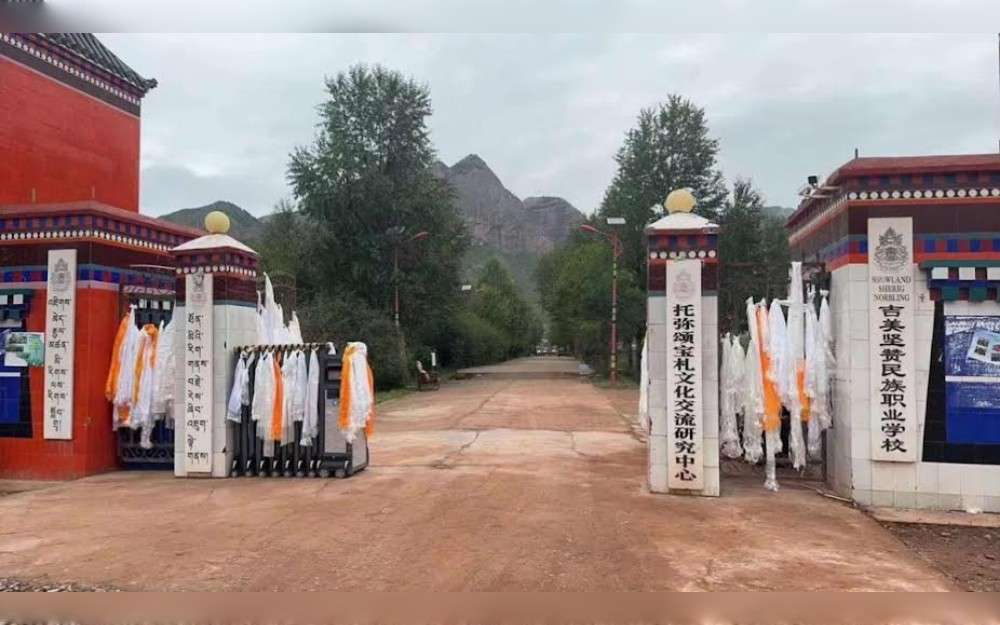
The Gangjong Sherig Norbu School has long been a source of pride for ethnic Tibetans in China’s Qinghai province. Known for its rigorous curriculum, the school counted leading Tibetan scholars as members of its faculty; its graduates have gone on to excel in fields like engineering, education, medicine and religion.
“It was there that I truly understood the significance of Tibetan language and identity,” Tenzin Woeser, a Tibetan songwriter who attended the school in the 1990s, told RFA.
So it was with tears in their eyes that students marked the last graduation Gangjong Sherig would ever hold after Chinese authorities closed the school this month, making it one of a growing list of Tibetan educational institutions that have shut. School founder and principal Ragya Jigme Gyaltsen said the Qinghai Provincial Communist Party had determined the institution did not meet its standards of instruction.
Chances are that the students who went or would have gone to Gangjong Sherig will now be sent to a Chinese-run boarding school that minimizes instruction in Tibetan in favor of a Mandarin-heavy curriculum that promotes party loyalty. The story of how Tibetans are educated has attracted international concern and reflects a tension between cultural preservation and national integration.
What is China’s education policy?
Tibetan students in the first half of the century were typically educated at home or in the hundreds of monasteries that dominated Tibetan culture and traditions. Some Tibetan children still attend schools where the medium of instruction is Tibetan.
But the vast majority are thought to now go to schools where the lessons are in Mandarin, with Tibetan courses limited to a single language class.
The Gangjong Sherig Norbu School is one of dozens of Tibetan institutions that have closed in recent years. Others include the Sengdruk Taktse School in Amdo Golog, Qinghai province, and the Drago Monastery in Kham Karze, Sichuan province. According to a Human Rights Watch report, the number of non-Tibetan-speaking teachers jumped in areas with ethnic Tibetan students. One goal, according to the report, appears to be to quiet restive regions through assimilation with the majority Han culture.
Visitors say young children who attend Chinese boarding schools are unable to easily communicate with older relatives who grew up studying Tibetan, creating a generational rift and worries about the loss of a unique Tibetan identity.
What do other governments think about China’s boarding schools?
China has come under increasing international criticism for its educational policies both in the Tibetan Autonomous Region and in Tibetan areas in the Chinese provinces of Qinghai, Sichuan, Gansu and Yunnan.
A panel of experts advising the United Nations human rights office said as many as 1 million Tibetan students now attend boarding schools and risk an “erosion of their identity.”
U.S. Secretary of State Antony Blinken said in August 2023 that China’s “coercive policies seek to eliminate Tibet’s distinct linguistic, cultural and religious traditions among younger generations of Tibetans.”
What’s China’s response to the criticism?
China bristles at the complaints. Officials note that much of the Tibetan population remains scattered, leaving boarding schools as the only effective way of ensuring students have access to quality teachers and educational resources.
Beijing says Tibetans aren’t forced to attend and many also include instruction in Tibetan language and history.
Officials also point to figures that show the number of Tibetans who can read and write (in Mandarin or another language) has increased dramatically, although official statistics are hard to verify and other surveys show varying literacy rates.
What are the concerns about Chinese-run boarding schools for Tibetans?
Gyal Lo, a Tibetan activist and sociologist who studied the boarding school system in China before fleeing into exile in Canada, told RFA that the schools serve to sinicize Tibetans, including children as young as 4-years-old.
At that age, it’s easy to overwhelm the Tibetan language the students use at home with the Mandarin instruction they are bombarded with every day in school. Attendance is compulsory in everything but name, as families that don’t send their children to the schools may be cut off from government benefits or job opportunities, he has said.
“The Chinese government has repeatedly tried to convert Tibetans into Chinese by eliminating the Tibetan way of life and identity. Now they are educating the youngest members of society to eradicate Tibetan identity,” Gyal Lo said. “This is the most dangerous policy.”
Edited by Jim Snyder and Boer Deng.
“Copyright © 1998-2023, RFA.
Used with the permission of Radio Free Asia,
2025 M St. NW, Suite 300, Washington, D.C. 20036.
https://www.rfa.org.”