



Restrictions reappear in major cities amid a surge in Omicron variant infections despite the zero-COVID policy.
By Gu Ting for RFA Mandarin and by Chingman for RFA Cantonese
Authorities in the southwestern Chinese city of Chengdu have imposed restrictions on the city in a bid to curb a surge in new COVID-19 infections, as residents complained of food shortages and panic-buying.
The 21 million residents of the city, Sichuan’s provincial capital, were ordered to undergo mass PCR testing, as entertainment venues and local schools were shut down in new measures announced on Tuesday.
Citywide, anyone wanting to access any public space including public transportation will need to present a green “health code” on the Chinese government tracker app, indicating a negative PCR test from within the past 48 hours.
Further restrictions and targeted lockdowns were also announced in Chengdu’s Jinjiang, Gaoxin, Wuhou, Chenghua, Qingyang and Jinniu districts, while the Chengdu Motor Show has been “suspended,” media reports said.
A Chengdu resident who gave only the surname Wu said traffic restrictions had meant less and less food on sale in stores and supermarkets, sparking panic-buying in some areas.
“There are very few people on the streets, and no vendors selling vegetables in the mornings,” Wu said. “There are no vegetables left in the supermarkets. I managed to get a few eggs.”
“Some of my friends are stockpiling food in their homes; the city authorities are telling people to stock up,” she said.
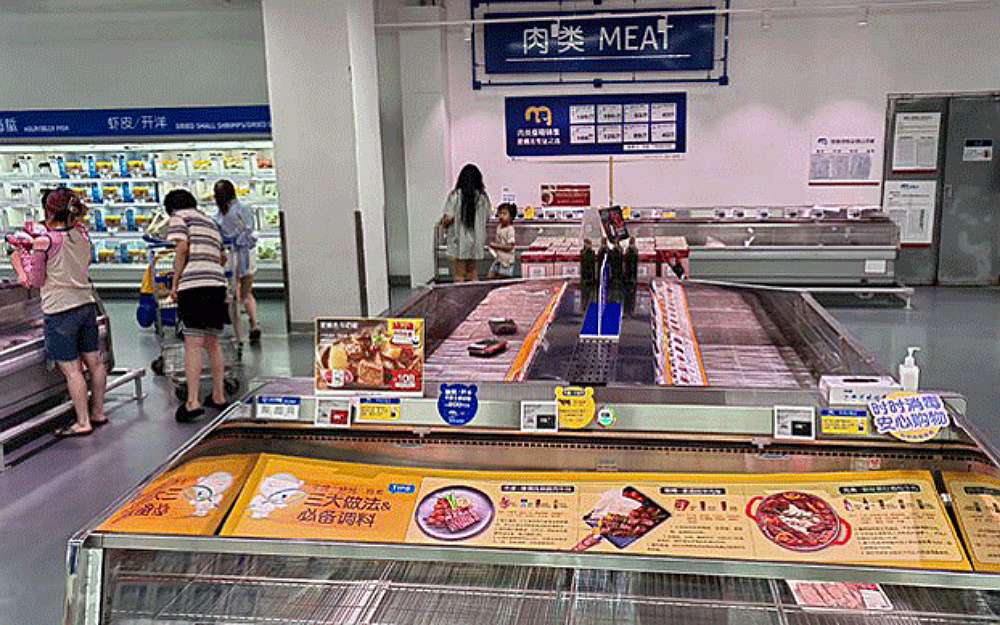
Photos of one supermarket in Chengdu posted to the social media platform Weibo showed empty shelves and freezer cabinets.
And a video clip identified by Twitter account @songpingganq as being shot in the early hours of Tuesday morning in Chengdu, showed mass screaming and shouting coming from several high-rise apartment blocks in darkness.
Wu described the situation in Chengdu as “pretty serious,” with some metro stations closed, and public transportation changing routes to avoid certain districts.
“They locked down a lot of residential compounds from yesterday evening,” she said. “There are a lot of people going to get PCR tests, which we have to do every 24 hours.”
“They start calling people on the loudspeakers at 5 a.m. to get up and go and do PCR tests … this is happening more in places like Century City, the high-tech zone and Jinnui district.”
The restrictions came as Sichuan provincial health authorities confirmed 276 new cases, 211 of which were in Chengdu, bringing the cumulative total in the city to 500 as of Monday, state media reported.
Gene sequencing results of the virus showed that the outbreak was caused by the Omicron variant BA.2.76, China’s Global Times newspaper reported.
“The strain has led to cluster infections in many places across the country due to its rapid spreading speed, strong transmission capacity and latent characteristic,” the paper said.
Outbreaks in other places
Local authorities are also battling COVID-19 outbreaks in Shanghai, Chongqing, Chengdu, Sichuan, Shenyang, Liaoning, Hangzhou, Zhejiang, Shijiazhuang, Hebei, Guangzhou, Guangdong, Xiamen, Yunnan, Kunming, and Tibet, with 1,717 newly confirmed cases nationwide during the past 24 hours, the national health commission said on Tuesday.
Authorities in the northern city of Shijiazhuang have shut down public transportation in and out of the city, while authorities in the southern city of Shenzhen have locked down Futian, Luohu and Longgang districts, shutting down 24 subway stations.
A resident of the eastern province of Shandong who gave only the surname Zhang said residents of Qingdao are being told to get PCR tests every four days.
“If you go more than four days without doing a PCR test you will get an amber code [on the health code app],” Zhang told RFA. “Getting to zero-COVID looks impossible now, and there are probably vested interests at work; some people who don’t want to get to zero-COVID.”
“The PCR test industry is pretty scary,” he said.
Zhang said local officials are far more likely to implement tough restrictions rather than see local cases skyrocket ahead of the ruling Chinese Communist Party’s (CCP) 20th National Congress later this year.
Meanwhile, a resident of the southwestern megacity of Chongqing who gave only the surname Li said local officials had tried to seal his front door after a neighbor gave them his address after testing positive for COVID-19.
“He gave them my apartment number instead of his,” Li said. “Now the neighborhood committee is trying to seal my front door.”
“Now I can open my door again, but I was so angry about it,” he said.
Translated and edited by Luisetta Mudie.
Copyright © 1998-2020, RFA. Used with the permission of Radio Free Asia, 2025 M St. NW, Suite 300, Washington DC 20036. https://www.rfa.org