



Kamran Reza Chowdhury and Sunil Barua/Dhaka and Cox’s Bazar, Bangladesh
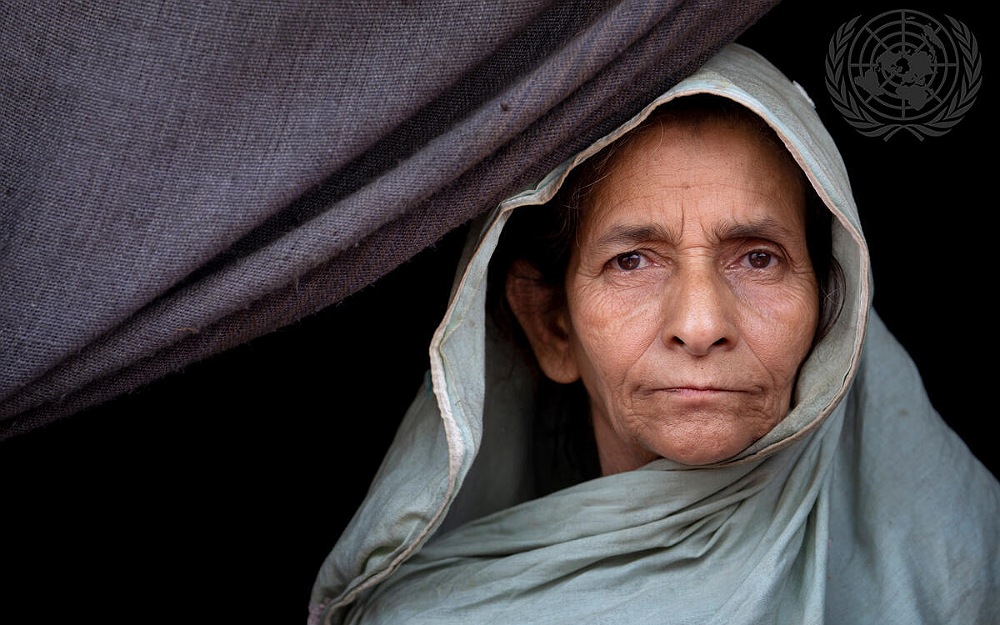
The way food aid is distributed to Rohingya needs to be adjusted because it is driving population growth in the country’s sprawling refugee camps in Cox’s Bazar, a senior Bangladesh government official said.
Asaduzzaman Khan Kamal, the home minister, suggested that because the food rations encourage Rohingya to have more babies, as he put it, the government intends to reduce food aid destined to the refugees.
“The Rohingya, irrespective of age, get the same amount of food. One adult man and a newborn baby get the same amount of food. Therefore, they give birth to more babies – 35,000 babies are born every year,” he told BenarNews on Monday, a day after he led a meeting of a government committee that coordinates and manages law and order at the southeastern camps along the Myanmar border that house about 1 million Rohingya refugees from nearby Rakhine state.
The committee discussed food allocation and other issues related to security, according to Khan.
“The Rohingya have more babies for more food,” he said. “We have decided that the quantity of food will be reduced. Our relevant agencies will work out a fresh standard of ration.”
The number of babies at the camps is about half of what Khan claimed, according to the United Nations Office for the Coordination of Humanitarian Affairs.
Responding to a BenarNews request for details, the office released a spreadsheet that showed there were 18,858 children younger than 1 in the Rohingya camps as of Feb. 28.
Md. Shamsud Douza, an additional refugee relief and repatriation commissioner under the Ministry of Disaster Management, told BenarNews that food allocations for Rohingya refugees are fixed in coordination with the World Food Program (WFP), a U.N. agency.
“Every Rohingya family gets a monthly food card with per-head allocations of 980 taka (U.S. $11.40) to 1,030 taka ($11.97). They collect rice and 19 other essentials from some designated shops fixed by the WFP, according to their requirements,” Douza told BenarNews on Tuesday.
He said his office had not received any directive about changing the allocations.
Officials at the WFP and UNHCR, the U.N.’s refugee agency, did not immediately respond to BenarNews multiple requests for comment on Khan’s proposal.
Criticism
Human rights activists, meanwhile, criticized the government, saying that cutting food allocations would not reduce the birth rate among Rohingya and such efforts could cause malnutrition and food insecurity.
Md. Jubair, the secretary of the Arakan Rohingya Society for Peace and Human Rights, said the allocations already fall short.
“We get a maximum 1,030 taka per person per month. With this small amount we buy 13 kilograms of rice, pulses, fish, salt, edible oil, vegetable and other essentials. It is very hard to run a family with this allocation,” he said.
Another activist said such cuts would have a negative impact.
“The amount of food aid given to each Rohingya family helps them live with minimum requirements. Further cutting it down is not acceptable because it would spell a disastrous impact on the health and food security of the entire Rohingya population, especially on the women and children,” Professor Mizanur Rahman, former chairman of the National Human Rights Commission, told BenarNews.
“If the government reduces food rations, then women would not reduce food allocations for their male family members and cut it for themselves and the children. In that case, the women and children will face malnutrition and food scarcity,” he said.
He added: “Everywhere in the world, poor people think of having more children for more food or more income and Rohingya must not be singled out in this regard.”
Nur Khan, a former executive director of Ain-O-Salish Kendra (ASK), a Bangladeshi human rights group, also challenged Khan’s comments.
“This is really unfortunate that we hear such an unfair comment about the food intake of the Rohingya. Talking about someone’s food is not decent,” he told BenarNews.
“The family planning workers visit door-to-door twice a week at camps and conduct counseling so they do understand the benefits of family planning,” Bhattacharya said, adding that agencies provide contraceptives including pills, injections and condoms.
“Compared to the situation in 2017 and 2018, the Rohingya people are friendlier to family planning,” he said.
Bangladesh has seen an influx of about 740,000 Rohingya since a Myanmar military crackdown against the stateless Muslim minority group in August 2017.
Copyright ©2015-2022, BenarNews. Used with the permission of BenarNews.