



The government wields far greater control over people’s lives than it did during the student-led movement of 1989
By Chen Zifei, Wang Yun and Jenny Tang for RFA Mandarin
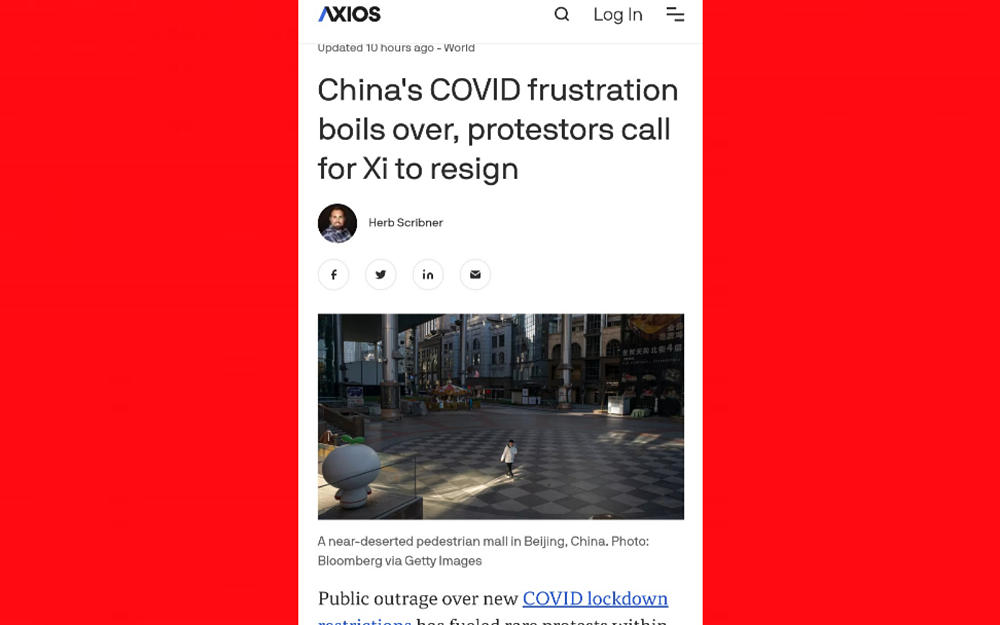
A wave of anti-lockdown protests in China following a deadly fire in Xinjiang’s regional capital Urumqi are unlikely to grow into a mass pro-democracy movement like that of 1989, given the degree to which the government’s “stability maintenance” system controls people’s lives, former student leaders and political commentators said on Monday.
Protesters took to the streets in more than a dozen Chinese cities on Sunday, calling for President Xi Jinping’s ouster in the biggest challenge to Communist Party rule in decades, according to media reports and video footage from social media posts of people on the ground.
Many came out to express condolences and solidarity with the families of those who died in an apartment fire in the Xinjiang regional capital Urumqi, which many have blamed on strict lockdown measures under Communist Party leader Xi Jinping’s zero-COVID policy.
Former student leaders from the 1989 mass pro-democracy movement, which ended with a massacre by the People’s Liberation Army around Beijing’s Tiananmen Square on the night of June 3-4, 1989, lauded the protests as evidence of a resurgence of public resistance to authoritarian rule.
Still, they appear unlikely to build into a coordinated movement, they told Radio Free Asia.
“The likelihood that these incidents will trigger a mass democratic movement on the same scale as the 1989 democracy movement isn’t very high,” said Hu Ping, honorary editor of the U.S.-based Chinese-language political magazine Beijing Spring. “But they are still symbolically very important; it shows people aren’t numb.”
“The people of China today don’t all agree with Xi Jinping and the Communist Party, as many people once imagined,” he said. These protests “show that the desire of the Chinese people for freedom and democracy never went away.”
Hu added: “It’s pretty earth-shattering and highly significant that people in mainland China are chanting ‘Xi Jinping, step down!” in public.”
‘Stability maintenance’
According to a recent report from the U.S.-based think tank Freedom House, people in China frequently challenge those in power, despite a nationwide ‘stability maintenance’ program aimed at nipping popular protest in the bud.
Despite pervasive surveillance, a “grid” system of law enforcement at the neighborhood level and targeted “stability maintenance” system aimed at controlling critics of the ruling Chinese Communist Party, the group identified hundreds of incidents of public protest between June and September alone, many of which were linked to the zero-COVID policy.
Miles Yu, former foreign policy adviser to the Trump administration, said there is a different demographic involved now, as the strict anti-virus policy hurts the interests of blue- and white-collar workers, young and old alike.
“For a long time, civil unrest in China came from the lowest ranks, from relocated households, migrant workers and so on,” Yu told RFA. “This time, it has affected the interests of the middle class.”
“The anti-lockdown protests have a broad base across the country, which is why the resistance movement is surging in China right now,” he said.
Different climate now
But Hu said the 1989 protests took place in a much more tolerant political climate than exists under Xi Jinping, who has continued to impose top-down controls on everything people do, see, read or say since taking power in 2012, building a nationwide state machinery known as “stability maintenance” to bolster his grip on power.
“Back then, the political climate was generally quite relaxed, and college students and young people had various ways they could express opposition to the status quo,” Hu said. “The situation today is the total opposite — the authorities clamp down on [dissent] with extreme severity … maintaining high pressure to maintain stability.”
But he added: “It’s particularly valuable that we are seeing these kinds of protests even under such circumstances as these.”
Perry Link, emeritus professor of East Asian Studies at Princeton University, said that while the weekend’s protests don’t approach the scale of the 1989 democracy movement, this level of public dissatisfaction was still a “meaningful historical event.”
“The last time someone shouted ‘Down with the Communist Party’ was during the 1989 student movement, so it’s particularly significant that people are shouting this slogan once more, more than 30 years later,” Link said.
Students entering the mainstream
Former 1989 student leader Zhou Fengsuo, who heads the U.S.-based rights group Humanitarian China, said it was inspiring to see young people coming out onto the streets.
“It was very exciting to see them singing the national anthem … demanding democracy, rule of law and freedom of expression,” Zhou said. “Suddenly, students were entering the mainstream.”
“It was an emotional experience for people who still cherish the ideals of the past to see these young people doing that,” he said. “The people stood up to demand freedom and democracy through their own struggle.”
Zhou said the protests also came as a surprise, given the level of government censorship and surveillance of social media platforms used to spread the word about the protests, particularly WeChat.
“The majority of Chinese people are still being brainwashed by the government, because all they can use is WeChat,” Zhou said. “This makes it hard to predict how this protest will go.”
Former 1989 student leader Wang Dan said it wasn’t always advisable to keep up momentum following a wave of mass protests, and said the weekend’s protests were more like a “small step” on a much longer journey.
“It’s a small step forward … and if you keep moving forward in small steps, you will definitely achieve your goal, even if you don’t get the entire Communist Party leadership and Xi Jinping to resign all at once,” Wang said.
“We should use … flash mobs, performance art and other methods, so the struggle can continue over a long period of time,” he said, calling for a list of government agents whose details could be handed to the U.S. government as leverage to ensure more lenient treatment of detainees.
“If someone is arrested, the people around them should get their name, and if too many are detained, people should surround the police station and try to get them released,” he said.
Punishing the perceived ringleaders
Wang Juntao, who heads the U.S. branch of the banned China Democracy Party, said the authorities are highly likely to start handing down harsh punishment to a minority of protesters they have decided were the ringleaders, while easing back on the zero-COVID policy without shelving it.
“They’re likely to take steps to appease the majority, while severely punishing a small group,” Wang said.
He said there are signs of a wider political awakening, even under Xi Jinping’s authoritarian rule, however.
“When things are quiet, the majority will likely conform and cling to the political system, and even emotionally identify with it,” Wang said. “But if something hurts their interests, particularly when it moves them emotionally, they will wake up fast.”
“The biggest bringer of enlightenment,” he said, “is actually the tyrannical rule of the Communist Party.”
Translated and edited by Luisetta Mudie. Edited by Malcolm Foster.
Copyright © 1998-2020, RFA. Used with the permission of Radio Free Asia, 2025 M St. NW, Suite 300, Washington DC 20036. https://www.rfa.org.